Table of Contents
ToggleYour upstairs <a href="https://www.housebeautiful.com/design-inspiration/g44510811/hallway-decor-ideas/” target=”_blank” rel=”noopener nofollow”>hallway doesn’t have to be a bland corridor between bedrooms. It’s the first impression guests see and the last space you experience before bed, why not make it count? A well-decorated hallway adds character to your entire home while serving practical functions like storage and wayfinding. Whether you’re renting or renovating, these upstairs hallway decor ideas offer actionable strategies to turn that often-forgotten stretch of wall and floor into a space you’ll actually enjoy walking through every day.
Key Takeaways
- Strategic use of mirrors and light paint colors can instantly make upstairs hallway decor feel more spacious and airier while improving brightness.
- Gallery walls transform blank hallway spaces into personalized focal points—plan arrangements with kraft paper templates and hang frames at eye level (57–60 inches from floor) for professional results.
- Layer your lighting with overhead fixtures, wall sconces, and dimmer switches using warm color temperature bulbs (2700K–3000K) to create both safety and inviting ambiance.
- Add functional storage with floating shelves, console tables, or built-in cubbies that serve double duty as stylish display surfaces without taking up floor space.
- Incorporate texture through hallway runners, subtle wallpaper, and woven accents to break up monotony and make the space feel designed rather than neglected.
- Start with one or two manageable upstairs hallway decor updates—like paint and mirrors—then build over time rather than overwhelming yourself with a complete overhaul.
Maximize Light and Space With Mirrors and Paint
A cramped or dark hallway feels smaller than it is. The quickest fix? Mirrors and fresh paint work together to open things up.
Place a large mirror directly opposite or adjacent to a window to bounce natural light deeper into the hall. Even without a window, a well-positioned mirror reflects overhead or wall-mounted fixtures to brighten the space. Frameless or thin-frame mirrors appear lighter than ornate wood frames, but choose what fits your aesthetic.
Paint color matters too. Light, neutral tones, think soft grays, warm whites, or pale greiges, make hallways feel airier. A crisp coat of quality interior paint (usually requiring 2 coats on existing walls) costs less than most decor upgrades and covers most hallway walls in a weekend. Prep is critical: patch holes, sand scuffs, prime stained spots, and use painter’s tape along trim. Skip prep, and your finish will look unfinished.
If you want contrast, consider an accent wall at the end of the hallway, a slightly deeper tone draws the eye and creates depth. Just remember that darker colors absorb light, so pair them with adequate lighting fixtures or reflective surfaces.
Create Visual Interest With Gallery Walls and Artwork
A blank hallway is wasted real estate. A gallery wall transforms it into a personal gallery that tells your story, and gives guests something engaging to look at while walking.
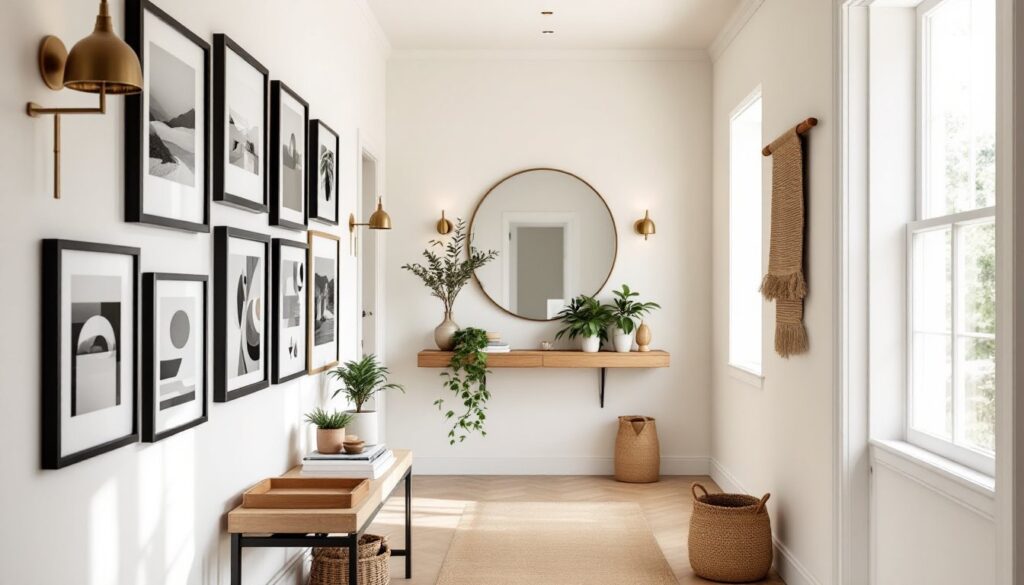
Gallery walls work best in hallways because the linear, confined space naturally guides the eye. Hang a cohesive mix of framed photographs, prints, or artwork at eye level (roughly 57–60 inches from floor to center of frame). A mix of frame sizes and matting styles, say, 3 larger frames anchoring 5–7 smaller ones, feels intentional and modern. Oversized single artwork (36–48 inches wide) also works if the hallway is wide enough.
Before you drill holes, lay out your pieces on the floor and use kraft paper templates taped to the wall to plan the arrangement. This saves you from multiple nail holes and second-guessing. Use appropriate anchors: for drywall, a toggle bolt or molly bolt holds 20–50 pounds, while a simple stud finder lets you screw directly into studs for heavier pieces. Picture-hanging wire distributes weight better than single-point hangers for large frames.
Choosing Your Gallery Wall Style
Three styles dominate hallway gallery walls. Salon-style (eclectic, varied sizes and subjects) feels curated and personal, perfect for mixing family photos with abstract prints. Grid-style (uniform frame size and spacing) looks modern and architectural, ideal for minimalist homes. Linear-style (frames in a horizontal or vertical line) suits narrow hallways and draws the eye naturally down the corridor.
Choose art or photos that relate thematically: all black-and-white, all travel-themed, or a consistent color palette. Mismatched prints in different frame colors read as unintentional rather than eclectic. Matte finishes reduce glare in hallways with overhead lighting.
Add Warmth With Lighting Upgrades
Poor lighting is the enemy of any hallway. Relying solely on a single overhead fixture creates harsh shadows and flat appearance. Layer your lighting for both function and ambiance.
Start with overhead recessed lights or a flush-mount fixture (ensuring at least 50 foot-candles for hallway safety). Add wall sconces on either side of a mirror or spaced 4–6 feet apart along the wall. Sconces flanking a mirror eliminate shadows when you’re getting ready, while spaced sconces create an inviting, boutique-hotel feel. Low-voltage LED sconces draw minimal electricity and run cool, making them ideal for tight spaces.
Pendant lights work if your hallway is wide enough (8+ feet) and ceiling height allows proper clearance (at least 6.5–7 feet from floor to bottom of fixture). A simple brass or matte black pendant every 4–5 feet creates rhythm and visual interest.
Consider warm color temperature bulbs (2700K to 3000K) over cool white or daylight tones. Warm light is inviting and less jarring at night or early morning. Dimmer switches (which many modern LED bulbs support) let you adjust ambiance without rewiring, a simple afternoon retrofit. Always hire a licensed electrician for hardwired fixtures, especially if you’re not comfortable working in electrical boxes.
Incorporate Functional Storage and Style
Hallways are the last place we think about storage, yet they’re ideal for it. A narrow console table, low shelving unit, or built-in cubbies store seasonal items, guest supplies, or decorative baskets while adding visual anchor points.
A floating shelf (secured to wall studs with a reinforced bracket) adds storage without bulk. Mount it 12–18 inches below eye level and style it with a mix of small plants, books, and decorative objects. Avoid overcrowding: a styled shelf should have breathing room.
If you’re ready for a bigger project, a basic built-in bench with cubbies above offers seating for kids putting on shoes and hidden storage behind doors. This requires some carpentry (cutting shelves, installing a frame, adding doors) and ideally measurement to fit your exact hallway width. For a rental, a stylish tall bookcase or apothecary shelf unit achieves the same effect without permanent changes.
Storage doesn’t mean cluttered. A few baskets on a shelf (fabric or woven, in neutral tones) hide chaos while looking intentional. Labels keep items organized so guests don’t stumble upon winter hat boxes in July.
Layer Textures With Rugs, Wallpaper, and Accents
Texture transforms a flat, sterile hallway into a rich environment. A hallway runner (2–3 feet wide, length depending on hallway) defines the space, adds warmth underfoot, and protects the floor. Choose durable materials like jute, wool blend, or polypropylene if foot traffic is heavy. Secure it with a non-slip rug pad underneath to prevent tripping hazards, essential in hallways where people move quickly or in socks.
Wallpaper, if your style permits, adds instant personality. A subtle geometric pattern or muted botanical print works in most homes: loud or dark patterns can close in a narrow space. Install wallpaper over properly prepped walls (clean, smooth, primed). If the thought of removing it later worries you, consider peel-and-stick wallpaper, easier to apply and remove, though not always as durable. Pair wallpaper with solid-color paint on one wall to avoid sensory overload.
Textural accents, a woven wall hanging, a simple macramé piece, or even floating wooden shelves with a raw or natural finish, break up smooth drywall. Hang a tapestry or textile art piece as you would a painting. Incorporate plants in hanging planters or on shelves: greenery adds life and improves air quality. Style your luxury decor ideas by mixing high and low: pair a thrift-store find with an intentional, curated piece.
Small touches matter: a few throw pillows on a bench, a decorative tray on a console, or framed botanical prints. These elements make hallways feel like designed spaces rather than afterthoughts. Keep accessories to 3–5 key pieces per surface to avoid clutter.
Conclusion
Your upstairs hallway is no longer just a throughway, it’s a canvas. From strategic lighting and mirrors to thoughtful gallery walls and textured layers, each of these ideas works independently or in combination. Start with what feels manageable: a fresh coat of paint and mirror, or a gallery wall and runner rug. Build from there. The best spaces evolve, so don’t pressure yourself to do everything at once. Hallways deserve the same care as living rooms, and the payoff, a space you’re genuinely excited to see every morning, is worth the effort.